
Why I'm Documenting My Last Decade Learning AI

Why I’m Documenting My Last Decade Learning AI
I’m 17 years into my career at Intuit. Principal Technical Data Analyst. About 10 years from retirement.
I should be coasting.
Instead, I’m learning Python API integrations, building AI-powered anomaly detection pipelines, and testing every analytics tool that promises to “revolutionize” my work.
Why? Because I can’t ignore what’s happening. AI isn’t coming for data analysts. It’s already here. And the question isn’t “should I learn this?”, it’s “how do I stay valuable when the tools can write my SQL, clean my data, and build my dashboards?”
If you’re mid-to-late career and quietly wondering “am I too late?” I’m here to tell you: f*ck no. But the approach is different than when you were 25 and had unlimited energy for learning curves.
This newsletter is me figuring it out in real time. And documenting everything.
The Problem
Here’s what I see happening:
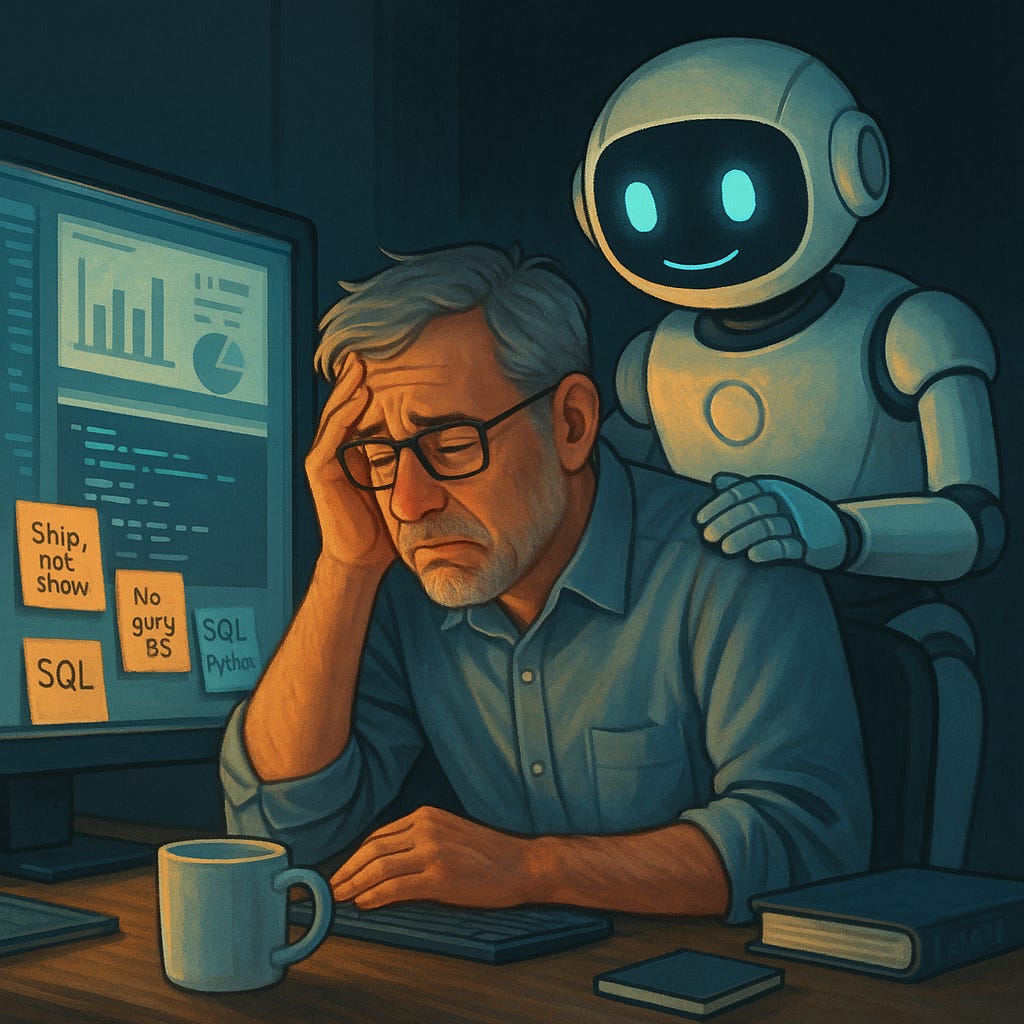
BI analysts are drowning. Manual data cleaning. Repetitive dashboard updates. The same “urgent” ad-hoc requests every week. Soul-crushing work that used to just be “part of the job.”
The tools are moving faster than we can evaluate them. Every week there’s a new AI analytics platform. Most are vaporware or wrappers around ChatGPT with a 300% markup. But some actually work.
The hype-to-reality gap is massive. Everyone’s showing polished demos. No one’s showing the broken v1, the edge cases that don’t work, or the “it took me 6 hours to figure out this API integration” reality.
And late-career professionals need different strategies. You can’t just “learn to code” for 2 years and rebrand yourself. You have a mortgage. Kids. A career you’ve built. You need practical, proven solutions you can implement now.
What I’m Actually Doing
I’m not theorizing about AI. I’m building production tools at work:
An automated anomaly detection pipeline that scans QuickBooks subscription data across multiple dimensions and uses Claude to prioritize what actually matters for stakeholders
Custom GPTs for data cleaning that save me hours of manual prep work
Automated BI dashboard intelligence that tells me what changed and why, instead of me hunting for patterns
And I’m testing everything else: Julius AI, Cursor, Claude vs ChatGPT vs Perplexity, the “vibe analytics” platforms everyone’s talking about. Documenting what works, what doesn’t, and what’s complete nonsense.
I’m learning in public because it forces clarity. If I can’t explain it, I don’t understand it well enough yet.
What This Newsletter Will Be
Real implementations with code. Not theory. Not “imagine if you could...” - here’s the actual Python, the API calls, the architecture decisions.
Honest assessments. Including the failures, the dead ends, and the tools I thought would be game-changers that turned out to be expensive disappointments.
Technical depth when needed, plain English when possible. I’ll show you the code, but I’ll also explain why it matters for your actual work.
Published when there’s something worth sharing. Not daily content to feed an algorithm.
No fluff. No hustle culture. No manufactured urgency. No “one weird trick” B.S.
For burned-out analysts who want to stay relevant without sacrificing their sanity or starting from scratch.
Who This Is For (And Who It’s Not)
This newsletter is for you if:
You’re a mid-to-late career analyst who sees AI coming and needs practical guidance
You want to see actual code and architecture, not just screenshots and promises
You’re tired of AI hype and want honest field reports from someone in the trenches
You have limited energy and need to prioritize what actually moves the needle
You want to leverage AI without becoming a data scientist or starting over
This newsletter is NOT for you if:
You’re looking for get-rich-quick schemes or passive income fantasies
You need Excel 101 or SQL fundamentals (though you might learn that stuff in context)
You’re an AI purist who’ll get mad when I say something isn’t ready for production yet
You want daily motivational content or “crushing it” energy
What’s Next
Next week, I’m walking through the AI-powered anomaly detection pipeline I built over a weekend.
I’ll share:
The architecture and design decisions
The actual Python code (complete with my comments and the parts that broke)
What worked, what didn’t, and what I’d do differently
Why Simpson’s Paradox (a statistical phenomenon that can completely reverse your conclusions) almost made me miss a crisis in the data
The exact API costs and time investment
If you want to see how to actually build this stuff instead of just reading about it, you’re in the right place.
A Note on Sustainability
I’m being intentional about this. I’ve seen too many side projects become second jobs that drain you. This needs to energize me, not exhaust me. The work has to be interesting, sustainable, and actually make my life better.
So far? I’m energized. I’m building cool shit. I’m learning tools that make my actual job easier. And I get to share the journey.
Come along for the ride. I’ll document the wins and the f*ckups equally.
Subscribe now and let’s build something.
— Bronson